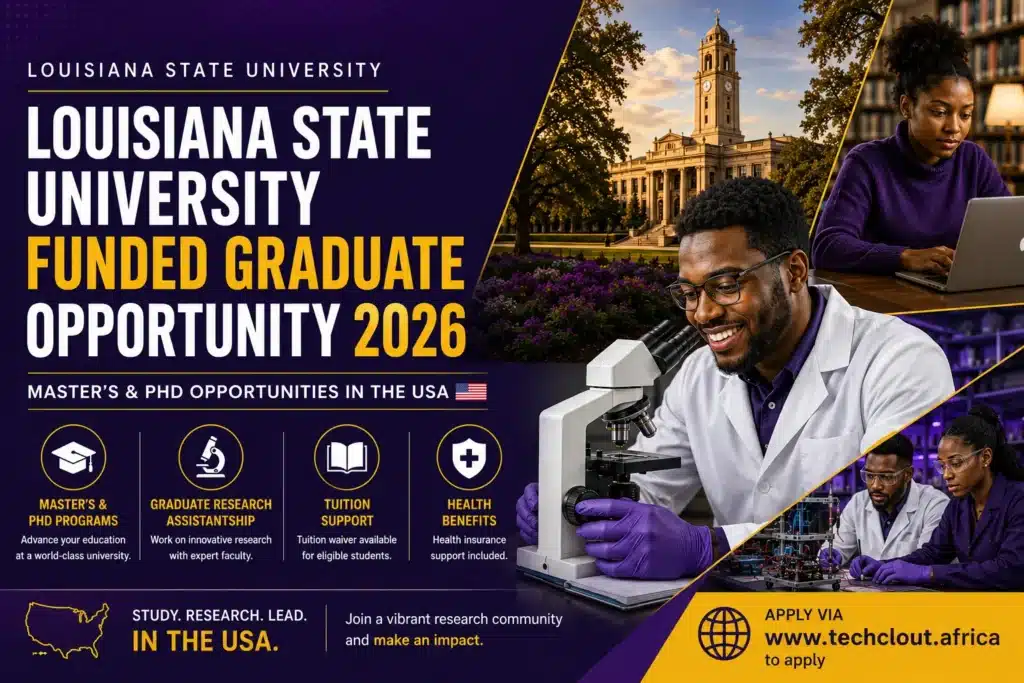
No IELTS required. Full tuition covered. $30,667 annual stipend. If you have a background in ecology, biology, or fisheries science and a passion for research, LSU wants to hear from you before June 30, 2026.
If you have been looking for a fully funded opportunity to pursue a PhD in the United States, this is one worth stopping everything for. Louisiana State University is offering a Graduate Research Assistantship through its Fisheries Ecology and Ecosystem Dynamics Lab, and the package on the table is as comprehensive as it gets.
We are talking about a $30,667 annual living stipend, full tuition coverage, and graduate fee support, all rolled into one position at one of America’s well-established public research universities. And the best part? No IELTS is required. The deadline is June 30, 2026, which means the window is still open, but not for long.
What Is This Opportunity About?
The Fisheries Ecology and Ecosystem Dynamics Lab, known as the FEED Lab, is led by Dr. Jeff Plumlee at Louisiana State University. The lab is inviting applications for a fully funded graduate assistantship, and the successful candidate will be appointed as a Graduate Research Assistant working on research that sits at the intersection of ecology, fisheries science, and human dimensions.
The research broadly investigates the ecological relationships of fishery-important species and the human dimensions surrounding their respective fisheries. At the heart of it, funding for the lab’s projects is primarily tied to understanding the trophic impacts of Harmful Algal Blooms (HABs) on estuarine fish and invertebrate communities, which is one of the most pressing and globally relevant areas of aquatic research today as climate change intensifies the frequency and severity of these events.
The student will use a variety of research techniques including natural biogeochemical markers, long-term fishery-independent data analysis, manipulative field experimentation, and mail and internet surveys. Each student-led project is designed to use a combination of multiple methods, giving you genuine breadth as a researcher. Work also happens in close collaboration with state agencies, recreational and commercial fishers, and academic partners, so this is not a desk-bound PhD. It puts you in the field, in conversation with real stakeholders, and at the cutting edge of applied ecological science.
All research findings from the FEED Lab are disseminated to stakeholders as part of your graduate responsibilities, meaning that communication and real-world impact are built directly into the program from day one.
What the Scholarship Covers
This is a half-time assistantship running at 20 hours per week, and it covers everything you need to focus entirely on your research without financial worry. The package includes a 12-month living stipend of $30,667, full tuition remission, and graduate fee support.
The program is set to begin in Fall 2026, with an official start date of August 24, 2026. Depending on project needs, an earlier start in 2026 may also be possible. For any international student or early-career researcher thinking about what it actually costs to live and study in the United States, this package removes the guesswork entirely. Your tuition is paid and you receive a living stipend every month for 12 months of the year. That is a solid foundation to build a world-class research career from.
Who Can Apply?
The position is open to candidates from all countries, making it genuinely accessible to students from Nigeria and across Africa. There is no IELTS requirement at the program level, which removes one of the most common barriers international applicants face.
To be considered, you need to hold a Master’s degree in ecology, biology, fisheries or aquatic science, or a closely related field. Other degree programs will be considered on a case-by-case basis, so if your background is adjacent and you have the relevant skills, it is still worth applying. You also need demonstrated experience in written and verbal communication, a basic understanding of the programming language R, and a formalized introduction to biostatistics.
These are not impossible requirements. If you have completed a research-focused postgraduate degree in a relevant field and have worked with data and scientific writing, you are already a strong candidate.
Why Louisiana State University?
Louisiana State University, commonly known as LSU, is a flagship public research university located in Baton Rouge, Louisiana. It is one of the major research universities in the American South and is classified as a doctoral university with very high research activity, which is among the highest classifications a US university can receive.
LSU’s location is also a genuine advantage for this specific research area. Louisiana sits at the confluence of major river systems and the Gulf of Mexico, making it one of the most ecologically rich and research-relevant environments in North America for anyone working in fisheries, aquatic science, and coastal ecology. You will not just be studying these systems in a classroom. You will be embedded in them.
Beyond the research environment, an LSU PhD opens doors across academia, government agencies, environmental consulting, and conservation organizations globally. A research doctorate from a well-ranked American university carries weight on CVs from Lagos to London to Los Angeles.
What You Need to Submit
The application process is straightforward. You will need to prepare a cover letter explaining your research interests and how your background aligns with the FEED Lab’s work, a CV that clearly outlines your academic qualifications, research experience, and relevant skills, and the contact information for three academic or professional references who can speak to your capabilities.
All of these documents should be compiled into a single PDF. Full details on how to submit your application, including where to send everything, are available when you click the apply link at the bottom of this article. Application reviews began on April 15, 2026 and are continuing on a rolling basis until the position is filled. This means that the earlier you apply, the better your chances of being considered before the spot is taken.
The official deadline is June 30, 2026, but given that reviews are already underway, waiting until the last day is a risk not worth taking.
This Could Be the Opportunity That Changes Everything
A fully funded PhD in the United States, at a research-active university, in a field that is growing in global relevance as climate change reshapes fisheries and aquatic ecosystems around the world. That is what this opportunity represents. For African researchers, particularly those with backgrounds in marine science, biology, or environmental studies, this is a rare and genuinely accessible door into the American academic research system.
Do not let the deadline pass while you are still deciding. Put your documents together, write a strong cover letter that speaks directly to the FEED Lab’s research focus, and submit today.
Join our Community & inside you get free access to premium Udemy courses, live tech job updates, scholarship and fellowship opportunities, and a community of professionals actually moving forward in their careers.
No fees. No paywalls. No gatekeeping.