
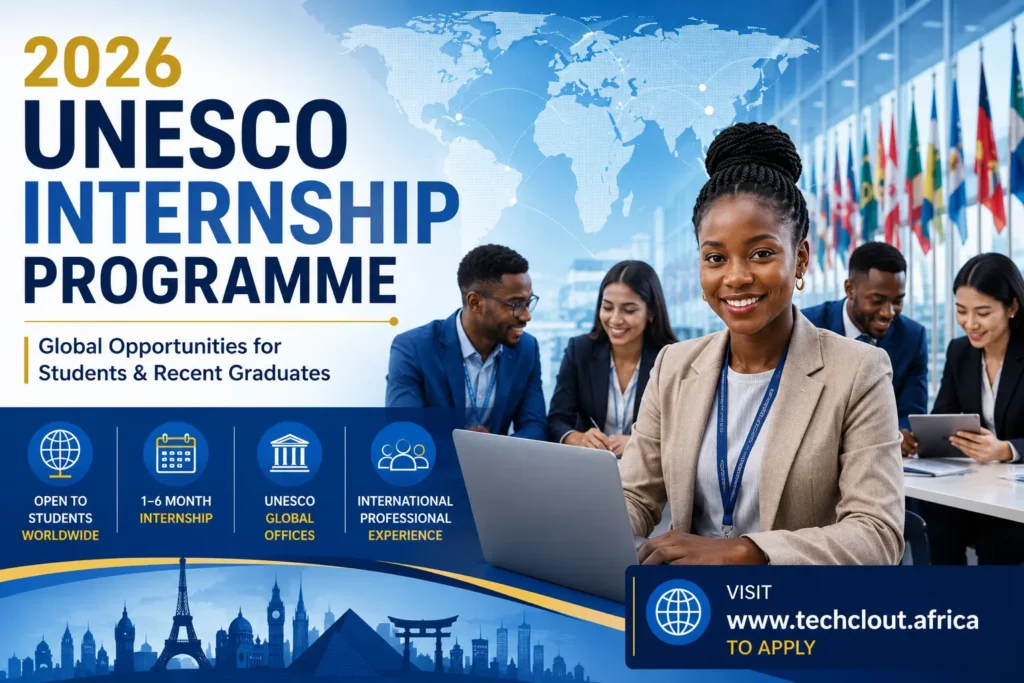
Imagine having UNESCO on your CV before you even graduate. Applications for the 2026 UNESCO Internship Program are open to students and recent graduates from every country in the world, and the deadline is June 30, 2026.
There are internships that look good on paper. And then there are internships that genuinely transform the way the world sees you professionally. An internship at UNESCO, the United Nations Educational, Scientific and Cultural Organization, falls squarely into the second category.
UNESCO is one of the most recognised international organisations on the planet. It is the body behind global initiatives on education, science, culture, and communication, operating across more than 50 offices and field stations worldwide. Getting the chance to work inside that structure as a student or recent graduate is not something that happens to many people. But right now, that opportunity is open, and the deadline is June 30, 2026.
If you are a student or a recent graduate looking to build real international experience, grow a global network, and add a name to your CV that opens doors for the rest of your career, this is the post you need to read all the way through.
What Is the UNESCO Internship Program?
The UNESCO Internship Program is a structured learning experience designed to give students and recent graduates hands-on exposure to UNESCO’s mandate, programmes, and processes. It is not a passive observation role. Interns are given practical assignments that directly enhance their academic and technical knowledge, preparing them for the realities of professional life in international development, policy, education, science, culture, and communications.
Right now, there are 14 active internship positions open across UNESCO offices in multiple locations around the world. The available tracks span a wide range of fields and departments, including Priority Africa and External Relations, Social and Human Sciences, the Office of the Director-General, the Natural Science Sector, the Governing Bodies Secretariat, the Division of Internal Oversight Services, the Intergovernmental Oceanographic Commission, the Culture Sector, Communications and Public Engagement, the Education Sector, Digital Business Solutions, the Communication and Information Sector, the Bureau of Human Resources Management, and All Sectors and Bureaus. That breadth is one of the things that makes this program genuinely special. Whether your background is in science, education, communications, culture, policy, or technology, there is a track that could align with your skills and ambitions.
The duration of the program runs from a minimum of one month to a maximum of six months, giving applicants flexibility depending on their academic schedule and personal circumstances.
It is important to be upfront about one thing: UNESCO does not provide financial compensation for interns. There is no stipend or salary attached to this program. What it offers instead is something that money cannot directly buy, which is real, substantive work experience inside one of the world’s most respected intergovernmental organisations, and a professional credential that carries enormous weight in almost every field you might want to enter after graduation.
Who Can Apply?
The UNESCO Internship Program is open to candidates from all countries, making it one of the most globally inclusive internship programs available at the international level. To be eligible, you must be at least 20 years old and meet one of the following academic criteria.
You must be currently enrolled in the third or final year of a Bachelor’s degree program, or currently enrolled in a second university degree such as a Master’s or PhD, or have completed your Bachelor’s, Master’s, or PhD degree within the last 12 months from the date indicated on your diploma.
For applicants targeting secretarial, assistant, or technical and professional assignments, you must be enrolled in the final year of a secretarial school or specialised technical institution, or have recently graduated from such an institution within the last 12 months.
Across all categories, you must have an excellent command of either English or French, both in writing and speaking. A working knowledge of the other language is an asset and may be required for certain assignments, particularly at UNESCO’s headquarters. You will also need strong computer and office software skills, the ability to work effectively in a team, and solid interpersonal and communication abilities.
One important note: candidates who have completed their full-time Bachelor’s degree but are not currently enrolled in a graduate programme are not eligible to apply. The program is specifically designed for those who are still studying or who graduated very recently.
What You Stand to Gain
Beyond the UNESCO name on your CV, the internship exposes you to a truly multicultural working environment that very few professional settings can replicate. You will be working alongside colleagues and stakeholders from across the globe, developing cross-cultural communication skills and an international professional perspective that employers consistently say they cannot teach in the office.
Your work will be directly tied to UNESCO’s active programmes and projects, which means the assignments you complete will have real-world relevance. This is not busy work. It is the kind of experience that gives you concrete, verifiable achievements to discuss in future job applications and interviews.
The exposure to UNESCO’s networks, processes, and approach to global challenges also positions you as someone who understands how international institutions operate, which is an increasingly valuable skill in fields ranging from public policy and development to journalism, technology, and beyond.
There is also the possibility that a strong performance opens doors to longer-term opportunities within the United Nations system. UNESCO managers around the world review intern profiles through the portal, and while there is no guarantee of placement or follow-on employment, being inside the system and doing strong work is always the best starting point.
Important Things to Know Before You Apply
The application process at UNESCO has a few specific requirements that are worth knowing before you sit down to apply. You must have your motivation letter and résumé ready before you begin filling in the application form, because once you start, you have only one hour to complete the process. Starting without your documents prepared is a risk you do not want to take.
Your application can only be submitted in English or French. If any of your supporting documents are in another language, you will need to provide an unofficial translation in either English or French before submitting.
Make sure that the contact details you provide in your application will remain valid for at least the next six months, as UNESCO managers from different offices around the world will have access to your profile throughout that period and may reach out if a suitable position becomes available.
It is also worth understanding how the selection process works. UNESCO receives significantly more applications from qualified candidates than it can place, so eligibility does not guarantee placement. If you are selected, a UNESCO manager will contact you directly. If you do not hear back within six months of submitting your application, it means your application was not successful in that cycle.
Apply as early as possible. Most positions close on June 30, 2026, though a few tracks such as the Culture Sector and Education Sector positions remain open until December 31, 2026. Regardless, with positions being filled on a rolling basis as managers identify suitable candidates, earlier applications always have a natural advantage.
Why African Students Should Not Overlook This
The UNESCO Internship Program is genuinely open to students from Nigeria and across Africa, and yet it remains one of the most underutilised international opportunities among African candidates. Part of this is awareness, and part of it is the assumption that these opportunities are designed for students from wealthier countries with more established connections to international institutions.
Neither assumption is accurate. UNESCO’s mandate covers issues that are deeply relevant to Africa, including education access, cultural heritage, scientific capacity building, media freedom, and sustainable development. African students bring perspectives and experiences that are not just welcome at UNESCO but are actually necessary for the organisation to do its work well.
If you meet the eligibility criteria and have the language skills and academic background required, there is no reason not to apply. The cost of applying is one hour of your time and a well-written motivation letter. The potential return is a career-defining experience at one of the world’s most impactful global organisations.
Apply Before June 30, 2026
The window for the 2026 UNESCO Internship Program is still open, but not for long. Positions are filled on a rolling basis, which means the best opportunities tend to go to those who apply early rather than those who wait until the final days.
Get your motivation letter and résumé ready today. Make sure they reflect not just your academic achievements but your genuine interest in UNESCO’s areas of work and your readiness to contribute meaningfully to a global team. Then submit your application and let your profile speak for itself.
A career that spans borders, cultures, and continents starts with one step. This could be yours.
Join our Community & inside you get free access to premium Udemy courses, live tech job updates, scholarship and fellowship opportunities, and a community of professionals actually moving forward in their careers.
No fees. No paywalls. No gatekeeping.